Addo Elephant National Park – Elephants and Spekboom – Summer Part 1
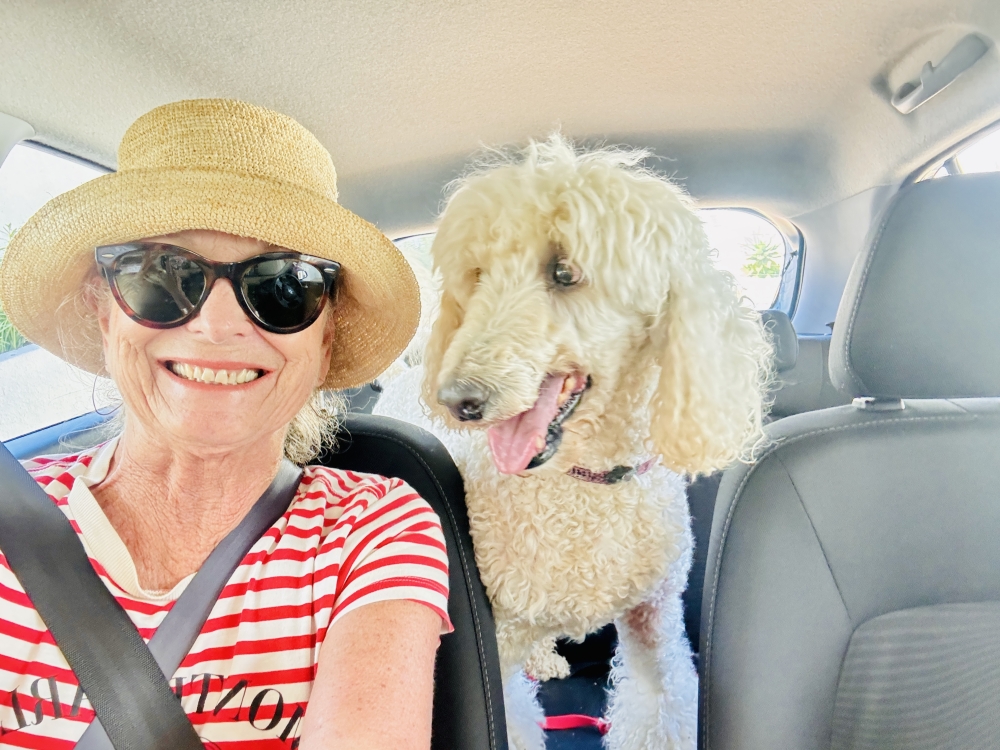
It’s November, and I can count the sunny, windless, perfect beach days on one hand. But there’s an expectancy of early Summer in the air. I can feel it on my shoulders when I walk.


The flowers on my walks have all gone to seed, and the fynbos, always rewarding, has changed. The daisies and vygies are dead, and now the bulbous plants are starting to fade as well. However, I’m hopeful that the hardier flowering plants and shrubs will produce blooms, the ones that favour drier, hotter, and windless weather. The wind may be pumping, but I’m ever sanguine for the sunny, windless days ahead. Come on, sun and super moon, bring on Summer.


Last night’s bloodshot red-faced sunset, although impressive, is devastating as the mountains around us burn. The veldfire restarted unexpectedly due to the wind, people are saying. The relentless wind has fanned those embers we thought the firefighters, helicopters, and rain had extinguished a week ago.


---oOo---
We three, Butch, the Honey Badger and I, took a leisurely drive and exited the Mountain Zebra National Park. Our time there was very special, and I think deep down we were reluctant to leave. But the road was calling, and we’d criss-crossed the park many times during our stay. It was definitely time to go, Butch said, as I kept fiddling and faffing around, doing “last-minute chores.”

We waved and then stopped to say goodbye to Wendy and Reggie. Marking time.

Our route took us through the districts of Somerset East and Hartebeeskuil, where the landscape boasted fields of dwarf aloes and a railway bridge reminiscent of the aqueducts in Spain. It felt like we were on a thrilling escapade, discovering new landscapes and experiences.


Kirkwood, a name I associate with children, “plaas kinders”, who were sent by train each term to board at Bloemhof (our sister, or rival school) in Stellenbosch, later settling as farmers’ wives in our beautiful Boland. They always spoke fondly of The Karoo, and now, I find myself in the heart of it.


---oOo---
The Addo Elephant Park is famous for two things, yes, you’ve guessed it, the first being Elephants and the second, I was somewhat surprised by. There are hectares of glorious, magical Spekboom, which is indigenous to the area.


The park boasts clean air, nature at its most prolific and wildlife in abundance. There was another surprise, but it’s personal, and I’ll tell you all about that a little later.


Addo Elephant National Park, one of our twenty “big, beautiful” national parks, is the third-largest national park in the country, after the Kruger National Park and the Kgalagadi Transfrontier Park in the Northern Cape.


It is not only home to the traditional Big Five, but also the Big 7, which includes the Southern right whale and the great white shark, in its marine environment.

The Park is ideally situated and just a short thirty-minute drive from Gqeberha (formerly Port Elizabeth). Visitors can expect to spot and identify a range of animals, from the small flightless dung beetles to the hundreds of grey mammoths.

Activities include self-drive game viewing and guided game drives on 4×4 trails, as well as short walks, longer overnight hikes, and bird-watching. Addo has it all!


---oOo---
History
The original section of the park was founded in 1931, in part due to the efforts of Sydney Skaife, to provide a sanctuary for the eleven remaining elephants in the area. The park has proven to be highly successful and currently houses over 700 elephants, as well as a large number of other mammals.


---oOo---
Expansion
The original park has subsequently been expanded to include the Woody Cape Nature Reserve that extends from the Sundays River mouth towards Alexandria and a marine reserve, which includes St Croix Island and the notorious Bird Island (read The Lost Boys of Bird Island), both breeding habitats for gannets and penguins, as well as a large variety of other marine life.
Bird Island is home to the world’s largest breeding colony of gannets - approximately 120,000 birds - and also hosts the second-largest breeding colony of African Penguins, with the largest breeding colony being located on St. Croix Island.
The expanded park encompasses five of South Africa’s seven major vegetation zones (biomes). It is also the only park to house Africa’s “Big 7” (elephant, rhinoceros, lion, buffalo, leopard, whale, and great white shark) in their natural habitats.


---oOo---
Flora and fauna
The flora within the AENP is quite varied, and like all plant life, is a central factor to the ecological system in place. Several species of rare and endemic plants, particularly succulent shrubs and geophytes, are native to the South African region within the AENP. Many species are under environmental pressure, however, and are facing the possibility of extinction.


Geophytes are a fascinating group of plants that have adapted to survive in harsh environmental conditions. These plants have a unique underground storage organ, such as a bulb, corm, or tuber, which enables them to store nutrients and water for later use. (The two photographs below are not Geophytes, they’re succulents)


Some geophytes have developed protective coverings to shield them from predators, while others have evolved mechanisms to survive drought or extreme winter conditions by entering a dormant state. (Examples of geophytes include tulips, daffodils, and crocuses.)

Geophytes play a crucial role in ecosystems, as they provide food and habitat for a variety of animals. They also help prevent soil erosion and contribute to biodiversity.


---oOo---


The park is home to more than 700 elephants, 400 Cape buffaloes, and over 48 endangered southwestern black rhinoceroses (Diceros bicornis occidentalis), as well as a variety of antelope species. Lion and spotted hyena have also recently been reintroduced to the area.


Two major environmental issues facing the AENP are extinction and overpopulation, which are interrelated.


There is a main camp, featuring a swimming pool, restaurant, floodlit water hole, and various accommodations, as well as four other rest camps and four camps run by concessionaires. The main entrance as well as two looped tourist roads in the park are tarred, while the others are gravelled. There is also an additional access road through the southern block of the park, which connects to the N2 highway near Colchester, joining the existing tourist roads within the park.


---oOo---
Magic Spekboom
We can buy Spekboom everywhere nowadays, it makes a beautiful pot plant, and I couldn’t stop smiling when I saw a somewhat withered Spekboom plant on my daughter-in-law’s windowsill all the way in Saskatchewan.


Emily, with the green fingers, is a master of container gardening, and I am not. Her plants thrive regardless of where she places them or how much attention they receive. In fact, I think they thrive due to the lack of attention they get. But the peaceful atmosphere in their home makes up for any shortfalls in devotion.

Portulacaria afra (known as elephant bush, porkbush, purslane tree, dwarf jade and spekboom) is a small-leaved succulent plant indigenous to South Africa. These succulents commonly have a reddish stem and small, round, waxy green leaves.

It is a soft-wooded, semi-evergreen, upright shrub or small tree. The Spekboom is a hardy, fast-growing, loosely branched plant.

It is rampant in the east of South Africa (as well as Eswatini). The plant is relatively rare in moist climates and tends to favour drier rocky outcrops and slopes.

In these environments, P. afra serves as a food source for multiple large herbivores, including the Black rhinoceros and the African elephant. Although it is not the primary food source for these animals, it still makes up a significant portion of their diet.


P. afra is resistant to drought, flood, and fire. When it is not the dominant species, Spekboom borders shrubland thickets and protects interior growth. Its growth rate is not dependent on water availability, and Spekboom can accumulate biomass in excess of what would be predicted by rainfall levels in the area.[Despite its ecological significance, ecologists in the region are advised to avoid introducing Spekboom in subregions where it is not already present, due to its ability to accumulate biomass rapidly.

Biomass: “Biomass refers to renewable organic matter derived from plants and animals, containing stored chemical energy from the sun, generated through photosynthesis. It can be directly combusted for heat or transformed into liquid and gaseous fuels through various processes.” From What is Biomass? Energy Theory.

The medicinal uses of the Spekboom:
- Sucking a leaf to quench thirst, treat exhaustion, dehydration and heatstroke.
- Using crushed leaves to provide relief for blisters.
- Chewing leaves can treat a sore throat and mouth infections.
- A poultice of crushed leaves is used as an antiseptic to soothe skin ailments such as pimples, rashes, insect stings and sunburn.
- In certain areas, the stems are used to help build huts/homes. The stems are dried and used as thatch for the roofs.
- In Mozambique, breastfeeding mothers eat Spekboom leaves to increase their milk supply.
- During famine, the Zulus eat the raw leaves.
On one of our game drives, we stopped at the bird hide for a spot of birding and to get a better view of the landscape, which was carpeted with Spekboom. Liam, our grandson, loves Guinea Fowl. When I see one, I try to take a photograph of it. (They are swift and brutal to get into focus. My reflexes are too slow.


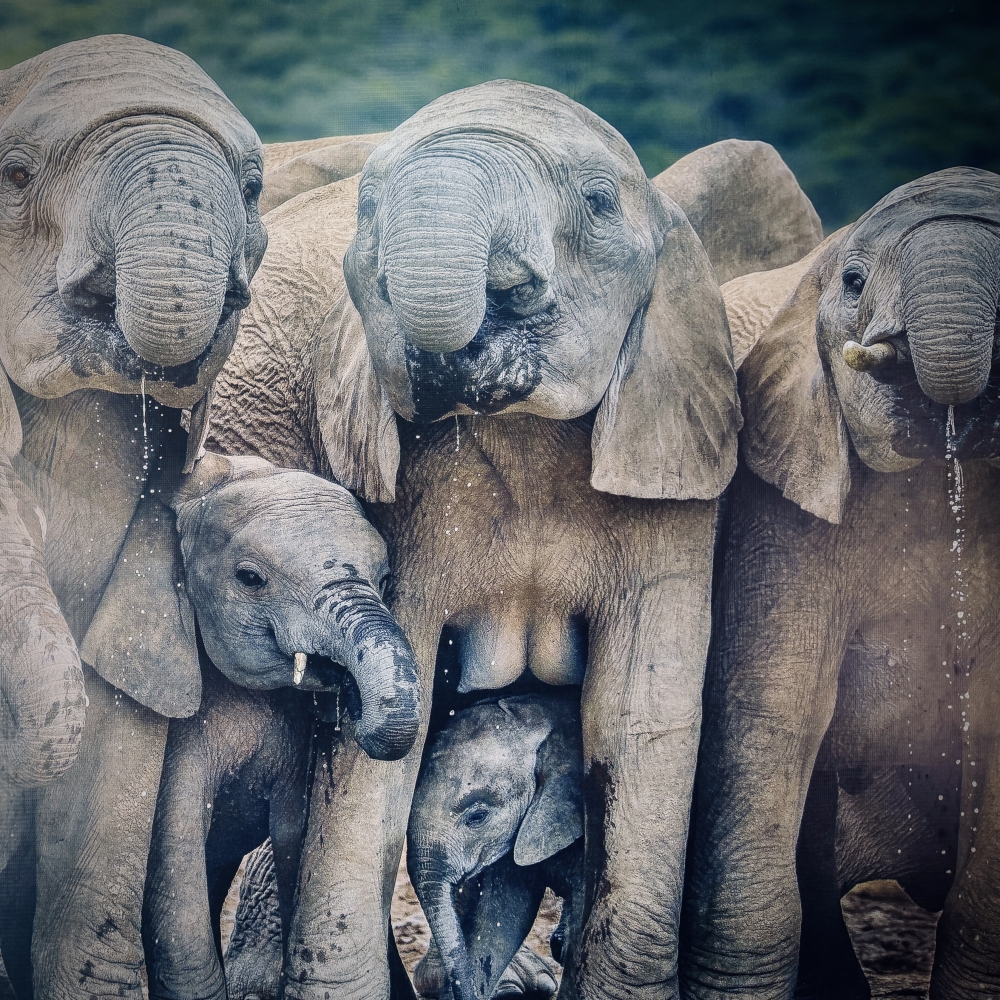
We were rewarded with a good elephant sighting at the watering hole where clans of elephant would gather at regular intervals and wallow, bathe, frolic in the muddy water, and quench their thirst at the fresh water inlet. When our tummies started rumbling, we moved on to Jack’s Picnic Site.


It was lunchtime and sandwiches were on the menu. I’d baked a loaf of bread the previous day, and our sandwich would feature fresh tomatoes, along with a slice of rare beef, mustard and salad greens.

My favourite spot to sit and have lunch when we don’t put out our picnic chairs will always be one of the steps leading up to the Honey Badger.

There I was minding my own business, enjoying my sandwich, when a grey sedan pulled up next to me and an American accent asked, “Where’ve you been in your truck?”
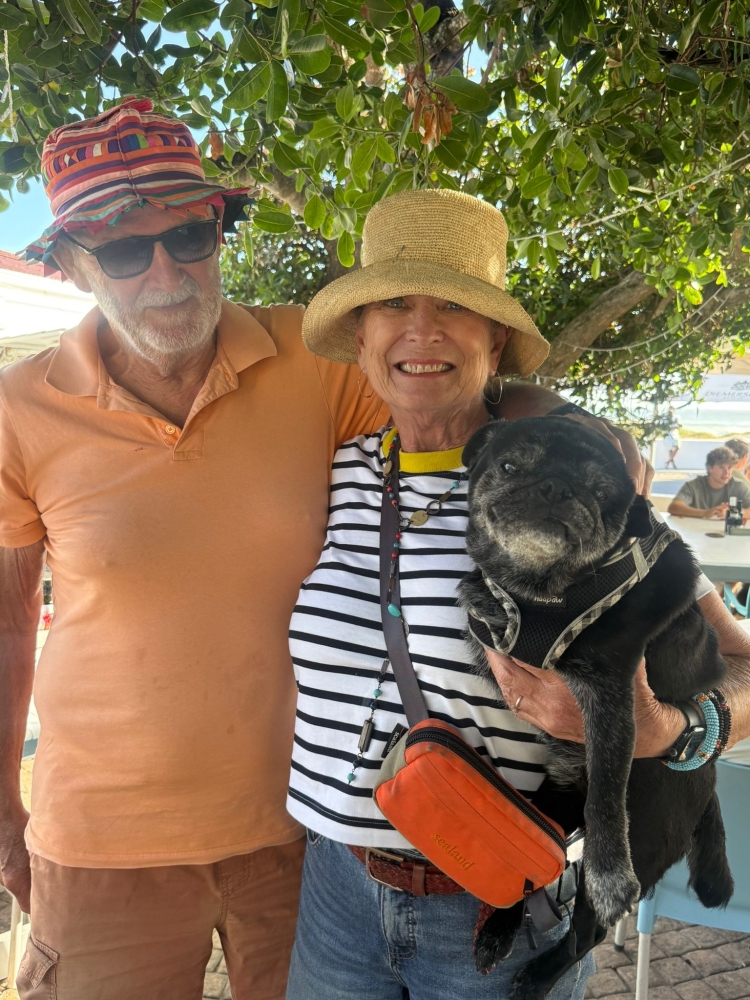
I looked up into the face of a man with a droopy, handlebar moustache and a big grin. Next to him sat a pretty lady with India-ink-black hair and a sultry olive complexion. She leaned over, smiled, and said "Hello" with a Canadian accent.
What followed was a lengthy exchange of questions and answers about our (and their) travels and adventures. These intrepid travellers had travelled extensively in South Africa and all over the world, and here we were all in the same spot.
Mark and Crez had retired to Mexico, but the extraordinary bond I immediately felt with Crez was that she originally hailed from Saskatchewan, a town not too far from where my children live. (That’s what we, South Africans, do when we meet people: the three leading questions are, where are you from, where did you go to school or university, and do you know so and so?)
On a few occasions, while we were in the Park, we’d see their car and stop to chat. It was terrific, and we promised to catch up again when they visited the Western Cape.
I would see, on social media posts, that this delightful, fun, and easygoing couple lived life to the max and were not retired, but definitely refired to travel, explore, and laugh their way through it all.
The first thing I did when I knew I’d be visiting my children in Canada was to message Crez to let her know. She responded immediately and said that if she could, we would definitely meet up.
Sadly, life had different plans for my sweet, gentle, dear friend Crez. I am heartbroken to think we’d not meet again.
“Each friend represents a world in us, a world possibly not born until they arrive, and it is only by this meeting that a new world is born.” Anaïs Nin.
---oOo---
During an inclement afternoon, we whistled through the interesting museum where we learnt all about elephants, their ancestors who had “pig-like” features and lived in African swamps over a million years ago. Now we have dugongs and hyraxes (dassies), which are the closest living relatives of today’s elephants.

For perspective, Butch posed next to Nqwebasaurus, a life-size reconstruction of Kirky, whose skeletal remains were found on the farm west of Kirkwood by Dr Callum Ross and Dr Billy de Klerk in 1996. Kirky lived approximately 135 million years ago and belonged to a group of carnivorous dinosaurs known as theropods. They walked erect on two legs, and their descendants evolved to give rise to birds ultimately.
---oOo---


Our final stop before leaving the Park was to walk through the Spekboom garden on a stormy day. Out came our plastic capes, and off we went, snaking our way through the lichen, succulents, air plants, and aloes—a quiet meditational stroll in a beautiful setting on a slightly muggy, wet day.


I suppose driving is easier on an inclement day. It makes leaving easier. I always think it’s a reflection of our moods. We will continue going south, and this time we’ll bypass Gqeberha, formerly known as Port Elizabeth. PE was founded in 1820 by Sir Rufane Donkin, who was the governor of the Cape at the time. He named it after his wife, Elizabeth, who had died in India. There was no wind on the sea as we passed the windy city.


---oOo---
The Addo Elephant Park had always been on my bucket list, and my daughter Lise’s visit to the park a few years ago sparked an even greater yearning to visit. I know, I’m a hopeless dreamer, imagining I’m walking in my child’s footsteps, breathing the same air, while reminiscing about her visit, I can picture her looking over my shoulder as we wander along the same dirt roads.


---oOo---
I dedicate this blog to the memory of Crez Rozdeba – rest gently. Your footsteps will always be there in the Addo Elephant Park, where your spirit will walk with giants. You hold a special place in my African heart.
Comments


Topics
Latest Photos