Nature Calls Ever North – Askam And A Meerkat Sanctuary
Our week in Springbok was nothing short of trouble and toil; even my watch seemed to suggest a moment of selfless breathing to recuperate. We needed to return to the quiet. A bit of dilly-dallying and a search on the SANParks website led us to a seven-night reservation at an exclusive campsite at Nossob in the Kgalagadi. We needed it, and for once the stars and Karma aligned to give us this break.

After a final check of our vitals, a restocked fridge, and full tanks, we shook Upington’s dust off our flip-flops and headed north to Askham for the weekend.
["photo id="16"]
Askam’s total population can’t exceed a thousand, including the district's farmers. It’s not much more than a pit stop. Dynamite comes in small packages and must never be undervalued. Don't judge Askam by one dusty street. It has everything a roadie needs.
There’s a filling station, an information centre, a Co-op, a general dealer, the Diamond T coffee shop, and some very nice campsites. We chose pharmacist Renée’s lovely oasis. Nestled under shady umbrella trees and green lawns, we found our perfect spot. We were exhausted, and this would be our footrest for two nights.
We parked the Honey Badger and set out our table and chairs on the softest green lawn, under a canopy of trees. At our campsite, Renee had gifted us three hot Roosterkoek. I wouldn’t be cooking for supper, as dinner was served! A scrumptious surprise.


On Saturday morning, after a late lie-in, we unhitched our bikes and set off for a long ride. A tortoise crossed our path as he travelled from one side to the other—an excellent opportunity to add footage to our Grandchildren’s playlist for later. The snake crossing the road was too fast, thankfully, as was the double crossing by the mob gaggle of banded mongooses dashing hither and thither. We passed a small Bushman outpost and were covered in dust when farmers whizzed by to shop in Askam.
["photo id="4"]
["photo id="5"]
["photo id="6"]
["photo id="7"]
["photo id="8"]
After our water and snack stop (at the 15km mark), I started to feel unwell. Dizzy, with leaden arms, and even my jaw hurt as if I’d been chewing cud all night, almost as uncomfortable as the cramps in my calves. Thankfully, this was the second time I’d felt this shaky, though not as severe. I knew I’d make it back to camp; unlike the first time in the Richtersveld, I knew I wouldn't pop my clogs. Renee, our hostess, gave me a diagnosis. Dehydration. After some electrolytes and a good drink of water, I’m happy to report I’m back to my old self. The sudden heat, dry air and irregular mealtimes have taken their toll on us oldies. We’re getting the knack for acclimatising, even if it takes time. I now dutifully take a regimen of fizzy tablets every morning for cramps, dehydration and energy.
Stopping for a milkshake at the Diamond T coffee shop did wonders, and we were soon ready to tackle the day's tasks. Take winter out of our Honey Badger and pack everything into our new rooftop locker. The name Diamond T comes from the motor car owned by the area's first farmer; he loved it so much that he called everything Diamond T thereafter.
["photo id="9"]
["photo id="10"]
["photo id="11"]
["photo id="12"]
Cardigans, sweaters, woollen socks, slacks and tights, winter linens and blankets have been bagged and stored for another season, far in the future. We all sighed in relief. The interior lockers closed with ease again, and we were in skinny tops and shorts!
["photo id="13"]
The opportunity to do some grooming came up in the afternoon, and I set about it with a wax pot, spatulas, and other paraphernalia. On close inspection, my pedicure wasn't much of a success. Multi-focals aren't ideal for the job; I felt like a million dollars! Time to celebrate.
["photo id="14"]
["photo id="15"]
---oOo---
On Sunday, we packed up early and headed ever north to the Meerkat/Suricate Sanctuary, twenty kilometres from the Kgalagadi’s main gate.
["photo id="17"]
["photo id="18"]
Anne Rasa, who passed away in 2020, owned it. Anne lived on the cattle farm she purchased in 2000. With help, she rehabilitated the dunes and veld, removed the cattle and goats, and let it go wild.
["photo id="25"]
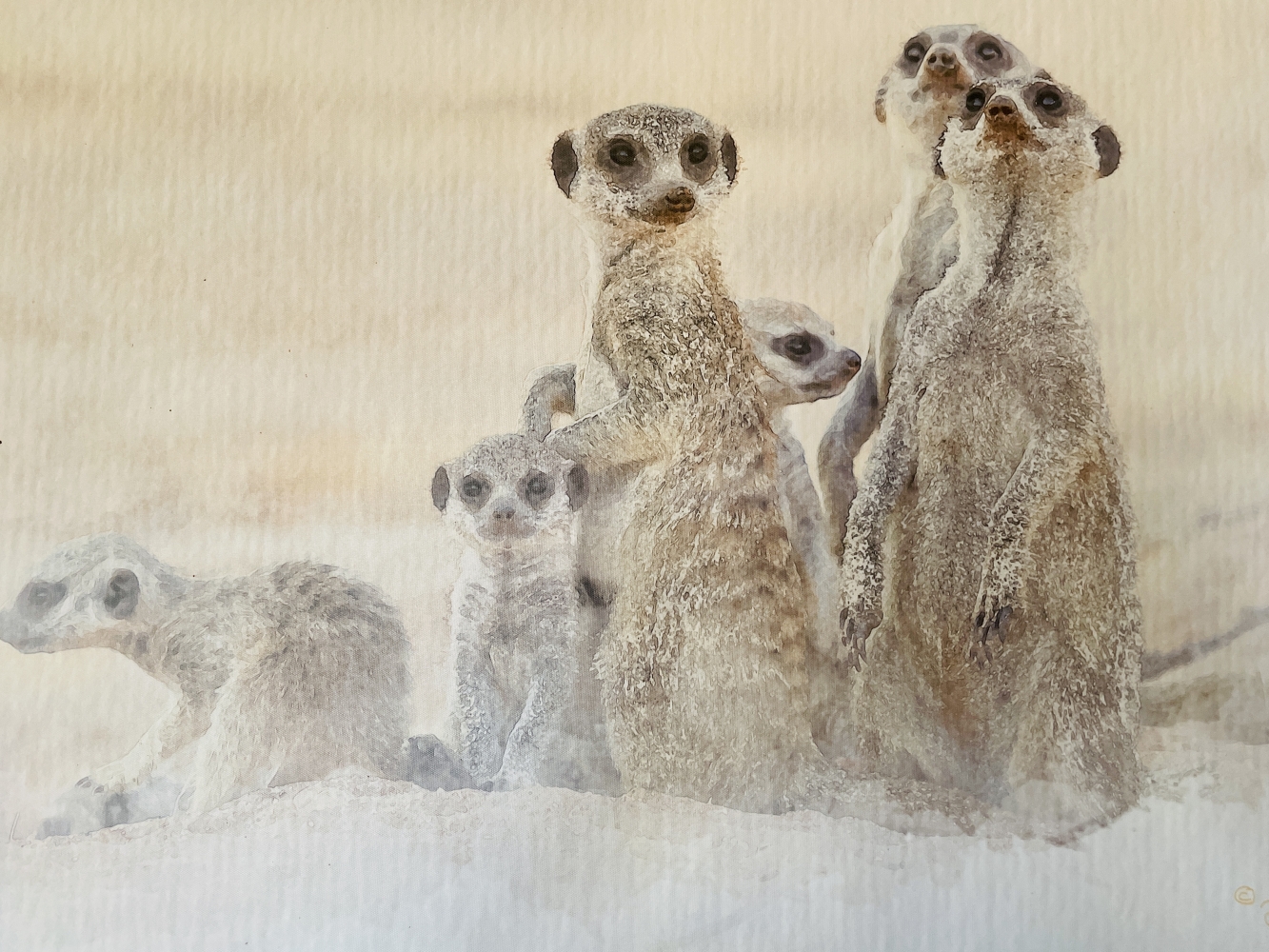
Mareli, the guide, met us at the homestead with her newly adopted orphaned Meerkat, Paddington, who chittered incessantly, vying for her attention. This hyperactive “child” kept her on her toes. Just seven weeks old and in her care for three weeks, Mareli was smitten. Where she went, he followed or crept into her sleeve for safety. She even allowed him into her bed at night, where he would snuggle up for comfort and warmth.
["photo id="19"]
["photo id="20"]
["photo id="29"]
["photo id="30"]
["photo id="31"]
Paddington was a victim of the poaching of wild animals. A concerned farmer would’ve sold him for R8k if he hadn’t spotted the newborn in captivity and rescued him. Contrary to popular belief, meerkats make terrible pets. The cute, cuddly baby soon becomes a demanding, possessive and jealous animal, causing havoc and destruction wherever he goes. Once owners are happy, they soon get bored with their tantrums and demands and neglect them. Meerkats are social animals and need to live in family groups to survive.
["photo id="22"]
["photo id="23"]
["photo id="24"]
Our campsite, set in the veld with the watering hole in view, was perfect; all we needed was to see Jock of the Bushveld run around to complete the picture. We’d outspanned. With our chairs and table set up under an Acacia tree, we did a spot of bird-watching and hoped the Eland spoor around our campsite was a good omen.
["photo id="26"]
["photo id="27"]
["photo id="28"]
["photo id="33"]
["photo id="43"]
As the air cooled later in the afternoon, we took a quick bike ride to watch the sunset over the dunes. Although skittish animals fled as soon as they caught our scent, we still saw several plains antelope.
["photo id="41"]
["photo id="42"]
On Monday morning, Butch started the week off on the right pedal, as one does, and took me out for a 42 km ride—the farthest we’ve ever cycled. We took the tar road to the Kgalagadi’s main gate—a gentle ride along the Nossob River. Up, up, up the gradient worked my muscles. “These hips don’t lie” went through my mind as I slogged on—a quiet road with only a few mules, cattle, sheep, goats, and ponies as onlookers. Separated by a little fence, we could see Botswana’s overgrazed, dry, red sand. If it pleased us this time, we could go, knowing there’s no deadline keeping us back.
["photo id="35"]
["photo id="37"]
["photo id="38"]
["photo id="47"]
["photo id="48"]
["photo id="49"]
["photo id="50"]
Mareli suggested we get up early one morning for a walkabout with her. Every morning, she inspects known Meercat burrows to see the newborns. She checks their condition and monitors their growth and survival rates, while updating on the behaviour of the rest of the clan. We were delighted to join her and see them in the wild as they went about their early-morning rituals, grooming, greeting, and later bouncing off to forage. The littlies peeped out and tentatively moved out. Later, as the sun rose, their confidence grew, and they followed mum as she guided and mentored them. We sat quietly on our bottoms, blending in so we wouldn't disturb or scare them.
["photo id="44"]
["photo id="45"]
Seeing the sun set red over a windswept Kalahari dune is everyone’s dream, and we took up Mareli’s offer to take us on a sunset drive to enjoy our drinks on a dune overlooking the vast farm. Later, we switched on flashlights when the evening star appeared, and the sickle moon shyly peeked over the horizon as we drove in a circle to watch nocturnal critters come out to forage.
["photo id="52"]
["photo id="53"]
["photo id="54"]
["photo id="55"]
Owls, hares, barking geckos, a lone klipspringer, a herd of Springbok standing stock-still, their eyes shining in the light. We were all hoping for an aardvark, of course. In the silence, Butch nudged me in the ribs. “Are you sleeping?” In the dead quiet, I’d started snoring. Busted.
["photo id="46"]
["photo id="51"]
I encourage you to consider spending a night or two at the Meerkat Sanctuary as an alternative to entering the Kgalagadi. You can also commute from there to the park for day drives if you can't find accommodation at Tweerivieren.
The rangers do a remarkable job of conserving the smallest animals, the Meerkat, and the park offers good accommodation options, e.g., cottages, rooms, or camping facilities. Mareli makes excellent iced coffee while visitors relax on the wrap-around veranda, enjoying the birds and Meerkat antics that abound on the “werf".
Anne Rasa, a Welshwoman passionate about nature, conservation, and animals, established it 30 years ago. After years spent in Kenya, she retired to the farm. Her story is remarkable and romantic, and it should inspire a film! Laurens van der Post also explored these dunes while searching for the Bushmen.
["photo id="56"]
["photo id="57"]
["photo id=["32"]
---oOo---
Kalahari Camelthorn Guest House and Camp Ground Askam
Rene': 082 330 6762 / Tobie: 072 437 6969
GPS coordinates S 26°58'54' S° E 020°46'55.9
Kalahari Trails Meerkat Sanctuary.
https://www.kalahari-trails.co.za/en/


Comments


Topics
Latest Photos