Our Final Fling In Mesmerising Mozambique
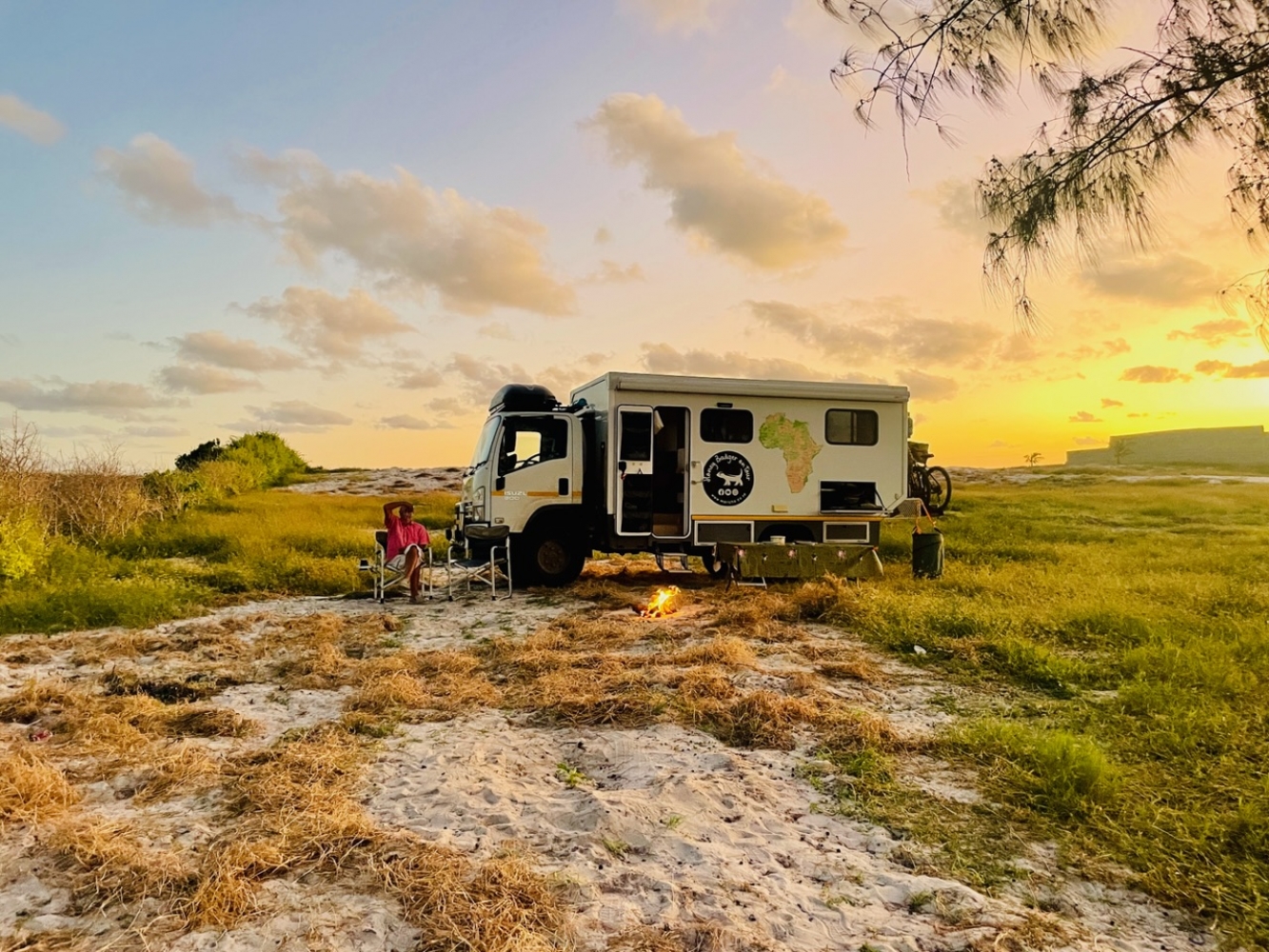
After our week of running around as tourists on Ilha de Mozambique, we were exhausted and needed to chillax on a quiet beach, just the two of us, before setting off on the long road to Malawi through Nampula Province.


Our friend, Pai Diesel, being the gentleman he is, wouldn’t let us go without making sure we were settled somewhere safe, then left us to our own devices. He suggested a remote beach north of Ilha, near the Coral Lodge on Mossuril Bay, where we’d had lunch the week before.

This time, our journey was not an eight-kilometre Dhow trip from Mozambique Island, but a fifty-one-kilometre road trip through busy villages and salt farms. Bags of salt are sold by the roadside and distributed across East Africa.


Nampula is believed to be home to the oldest surviving Portuguese buildings in the Southern Hemisphere, including the Church of Nossa Senhora dos Remédios in the village of Cabaceira. But that rendezvous would have to wait.

---oOo---
Our destination would be the beaches of Chocas Mar, at the far end of the Mossuril Bay spit, a popular Mozambican holiday resort.


Homes are mostly built from local materials such as mud and stone, with grass, palm frond, or thatched roofs, and are always significantly affected by tropical cyclones. Cyclone Gombe destroyed an estimated 1600 houses a few years ago. Colourful brick-and-mortar homes are being built as people's wealth and circumstances improve.


First impressions often last, and we should’ve listened to our inner voice when we stopped at the first lodge. The arty, bohemian Carrusca Mar & Sol, where the cool, dreadlocked manager greeted us with all the hipness of a hippie.
He assured us we were welcome to camp. The campsite was in a sorry state, hidden behind a dune in a clump of reeds, weeds and grass, with no view and the scorching sun beating down on us. We were thoroughly unimpressed and said so. After some thought, he relented and showed us a unique spot adjacent to a casita. Much better. He traipsed off unenthusiastically to fetch a key to the cottage’s ablutions while we said goodbye to Diesel, who would catch a ferry home.
Half an hour later, Butch went to find the key. What happened, I’ll never know—long story short. We were evicted. The owner, who was MIA, said she had guests booking in for three days and needed the cottage.
We searched for alternative campgrounds. There weren’t any. Just before sunset, we spotted a tiny makeshift reed hut on a large plot of unoccupied land. We scouted the area and found a comfortable spot on the seaside of the dune, with a magnificent view of the setting sun and the azure sea.

A short distance from us, fishermen cast their nets, mended their boats, and prepared for the night’s fishing. It didn’t take long for the “manager” of the plot to come over and negotiate a very reasonable fee for our three-night stay.


He returned a while later, squatting on his haunches a few inches from our fire pit, and he eyed us cautiously but in a friendly way. For a few hours, while we set up our campsite, made our fire, and prepared dinner, we answered questions about the truck and showed him where we'd come from and where we'd been. He couldn't get his head around the "this is our home" part of the story. We were delighted to share our supper, which pleased him and set us on an amicable footing for our stay.


After supper, he disappeared, and we only saw him when a stranger vied for our attention or demanded a camping fee. We assured him he was our main man, which pleased him, and he settled down out of sight.

Our days were sublime. We walked, read, slept, ate and did little else but soak up the sun. Occasionally, I’d dip my toes into the warm waters or go beachcombing. Shells were plentiful, brought in by the tides every evening and left on the white sands every morning. As handfuls of sand ran through my fingers, the thought that these tiny particles would outlast me by a thousand years always made me realise how insignificantly small my existence is.


Alas, I could only enjoy my stash of shells there, and I returned them to their rightful place just before we set off. The tides will wash them this way and that in the ebb and flow until they’re smooth or reduced to grains of sand on the beaches.


We saw only one couple on one of the verandas we'd been unceremoniously dismissed from. I think we got the better deal.


Once, we decided to trek all the way down to another beachside lodge for lunch. Luck and language were not on our side again. This time, the waiter got it all wrong. While all the other diners enjoyed their lunches, we were ignored. He left our glasses empty and whisked the menus away from under our noses after taking our order.

An hour later, when we realised the chicken piri piri was still on the grill, Butch, his throat parched, asked for our order. The waiter, poor sod, had forgotten to take our order. To his detriment, the restaurant owner sat two tables from ours, enjoying his Gatão vinho verde and grilled fish.
That was my chance to browse the shell market and take pictures of the beach umbrellas while Butch did his civic duty by reporting the incident. By the time we returned to our Honey Badger, we were both hangry, hot and humourless.


---oOo---
All our mishaps, misunderstandings, and Butch's recurring colly wobbles dampened our stay, so we decided to pack up and head north.


The Church of Nossa Senhora dos Remédios, situated in the middle of nowhere, was under renovation. I had to conduct my inspections surreptitiously, without the workers spotting me snooping under their scaffolding. Although beautiful, these churches leave me spiritually cold, leave the communities unchanged, and leave the spiritual leaders nowhere to be seen.


The landscape around Nampula in northern Mozambique includes several granite outcrops. Mount Ribáuè, also known as Monte Ribáuè, comprises two granite inselbergs separated by a narrow valley about 3 km wide. The eastern inselberg is Mount M’pàluwé.


The lower slopes are mostly cultivated. Dry miombo woodland occurs on the middle slopes and in the valley between the east and west peaks. The highest peaks are mostly bare granite, with pockets of montane heathland. The mountain has no year-round streams, but several intermittent streams flow during the rainy season.


---oOo---
After a long day’s drive on roads off the tourist routes, with few camping options, we decided to wild camp off the main road, adjacent to a football field near a small rural village.


We had just set up camp and were about to pour ourselves a drink when a truck pulled up. A burly man approached us, introduced himself, and apologised for the intrusion, but felt he needed to warn us that our site was not safe.

He was a civil engineer working just a kilometre away, and he told us about the opportunists who’d trespassed on their secure encampment. He suggested it would be safer for us to find a campsite in the village. We were grateful he’d warned us after his busy, exhausting day. In a jiffy, we were back on the road.


We went to the local police station and asked for permission to stop there. They welcomed us warmly, and we spent the night. The two ancient night guards were delightful and settled two metres from the truck, keeping each other company and making us feel safe. We slept like babies under police protection at a very peaceful station.

Believe it or not, our only disturbance was the endless shunting of the longest trains. We thought it was only a ghost train, but we were proved wrong the next day when we stopped at a railway crossing.
---oOo---
Although very similar to our previous trip to Ilha de Mozambique through Tete Province, the landscape was exciting and varied, and the inselbergs were beautiful. We stopped for snacks, fresh fruit, and salads for supper, and always marvelled at the high quality of the products sold along the road.


I have come to enjoy my shopping sprees at the local markets and roadside stalls, and now I find it difficult, almost traitorous, to buy fresh produce in a supermarket. Supporting local producers and traders keeps their businesses alive and growing. I must confess I think the produce sold is organic, more flavourful, and fresh off the vine. It is also good to know the source.


The light-hearted banter and teasing with the stall owners and "assistants" is always fun and often my only other conversation all day.


---oOo---
Monte Lampala, at about 1200 m, was the most impressive granite mountain. But the most surprising sight was the Rio Malema in the district of Malema, near the town of Malema. The district depends on agricultural production; the primary crops are sorghum, corn, peanuts, and onions. A way-station on the southern network of Mozambique Railways and on EN 13 serves it.


Railway tracks crisscrossed our route numerous times, as the straight rails divided the province from the east coast to Malawi and beyond to the west.


We have since seen many streets named after Nelson Mandela, Azania, and Sisulu, and I must confess it pleases me greatly to see “our” familiar names on signposts by rivers, on streets, and even in towns. Nostalgia is a strange emotion.


Once upon a time, strangers who learned we were from South Africa would ask, “Do you know Chris Barnard?” Nowadays, heart transplants are a dime a dozen, and that pioneer has faded from memory. Still, Nelson Mandela, like Gandhi, is everyone’s hero, and we’re often asked about him.

---oOo---
We were determined to spend a few days on the shores of Lake Malawi or Lake Niassa in Mozambique before our final farewell.


“Lago Niassa in Mozambique is an African Great Lake and the southernmost lake in the East African Rift system, located between Malawi, Mozambique and Tanzania.”
It is the fifth-largest freshwater lake in the world by volume, the ninth-largest by area—and the third-largest and second-deepest lake in Africa. Lake Malawi is home to more fish species than any other lake in the world, including at least 700 species of Cichlids. The Mozambique portion of the lake was officially declared a reserve by the Government of Mozambique on 10 June 2011, while in Malawi, part of the lake is included in Lake Malawi National Park.


Lake Malawi is a meromictic lake whose water layers do not mix. Lake Malawi’s permanent stratification and oxic-anoxic boundary (related to oxygen in the water) are maintained by relatively small chemical and thermal gradients. Wiki.
Imagine my surprise when we rounded a bend in the road and, far below us, lay this vast expanse of water, stretching for miles in every direction like a sea. This is no Worcester Dam. I was speechless.


We slithered down the winding road into the village nestled on the shore. The search for a campsite in this remote area, where tourists seldom venture, was on.
Eventually, we found an old, neglected sign for Cetuka Chiwanga Beach Resort. On closer inspection, we assumed the resort had been abandoned, but soon two toddlers came running over, with their father, Erasto, in hot pursuit.


Erasto informed us that the owner was out of town, but we were welcome to camp. He could arrange an electrical point in one of the cottages.


We could arrange cold bucket showers. A large blue plastic chlorine container was filled with water—a supply we could use to scoop water over ourselves for a shower. Thankfully, we have the best shower in Africa.


While Erasto leaped into action, tidying around us and sweeping leaves and twigs into heaps, we took it as our signal to sneak off to the beach with the twin boys. While they snacked on baobab pods, we sipped our drinks, enjoying the tangerine sunset over the lake. This was the quiet before the storm.


A long day ended; we were only interested in our steak and bed. While Butch was packing his fire, I prepared our salad and veg. Out of the corner of my eye, I noticed a slender guy approach us as I set the table. Like Slick Rick, he wore a gleaming gold satin shirt, board shorts, and Crocs. Saturdays were party nights, and the ghetto blaster was thumping in the distance.
Sauve could be his middle name, I thought. Cool as a cucumber, he introduced himself as Austen, the local pastor. Slightly taken aback, Butch thought he was a DJ. Pulling up a chair, he informed us that he would facilitate the “negotiations”. Dawdling sheepishly behind him, the camp manager Erasto followed suit, opening his beach chair. (I would remember him as Austen Powers.)
The rules of engagement were laid out, but Butch listened, arms and legs folded, as Pastor Austen delivered his address. After a long volley, Butch thanked him and cut the petitions short. He informed them that fees had been agreed and that we’d be on our way in the morning. He wasn't interested in any further discussion; his coals were ready, he said, as he picked up his braai tongs.
In a true gospel-like fashion, the manager picked up his chair and walked. Pastor Austen tried to pour oil on troubled waters, but Butch had none of it. Being a patient man and seeing my eyeball, he relented and gave the man a second chance. It turned out a donation to the mission would’ve sufficed. With that, Butch picked up his ball and left the negotiations unceremoniously.
Lost for words, Austen Power’s sails were suddenly deflated. He had no choice but to limp off, deflated and defeated. Our electricity connection was unceremoniously switched off, and we had to pay 1000 meticais for five litres of water as our reward for not being taken in by a smooth operator.


We had the distinct impression we’d overstayed our welcome in Mozambique. It was time to scoot on. With a bitter taste in our mouths, we settled our bill and headed for the Malawi border to continue our journey along Lake Malawi. It turned out to be a Hidden Blessing!


---oOo---


Our final night in Mozambique would be our best on the road. We’d just survived a speeding ticket. It sounded ludicrous, given the speeds we were travelling at. The wily traffic officers set up their cameras just after a notice indicating a speed reduction, which signalled the start of a village or school. Wham, we were caught on camera.
We pulled in at a crossroads filling station and decided that was it. We’d had enough and would park with the truckers. The guard approved, and we paid him a small fee. When we heard the baritone rumble of the big boys starting up at daybreak the next morning, we took that as our cue to get moving.


---oOo---
The following photographs are a selection of images, in no particular order, of rural life as I saw it on our journey.


Comments


Topics
Latest Photos