My Namaqualand Journal - Madeliefie, Pietsnotjie, Katstertjie -
Every year around this time, I remember Oom Piet and his visits, which fill me with warmth and nostalgia and inspire me to appreciate shared stories and traditions.

The metallic clanging of a shifting spanner on an engine part would signal the last chores being done before he’d set off.


Easels, cardboard boxes of squashed, twisted paint tubes, and plastic bottles filled with myriad paintbrushes, palette knives, and pencils littered the floor. Canvases in progress covered the rumpled bed. Along the remaining walls, hardboard and plywood were stacked, and a few garments hung from hooks. Sun-filter curtains were tied back with red post office elastic bands—the life of a gypsy.

After slamming the screeching engine shut, Oom Piet would brush the tousled fringe off his grease- and paint-smeared forehead and, with a roguish twinkle in his eyes, wish us well. We’d wave. A gaggle of children would run down the road, sending him on his way as his Kombi (circa 1964) billowed balls of grey smoke, choked, rumbled and coughed while the exhaust spewed noxious gases. We’d pray he’d not succumb to the turpentine fumes suffusing his cramped quarters. With a toddler on my hip, regurgitating his last feed, I’d wonder why he did it.


Memories of Piet van Heerden came flooding back as we meandered through Namaqualand last weekend. He couldn’t wait to get away. This slightly stooped, small man impatiently wrung his hands and bounced on the balls of his feet, anticipating his sojourn in the wilds.
Thirty-five years later, I still feel the intoxicating beauty of Namaqualand's landscapes, which Piet found so inspiring that he covered every inch of canvas with vibrant colours, reminding me why this region's scenery stirs such nostalgia and appreciation for nature's grandeur.

Near Kamieskroon, I saw the quiver tree nestled in rocks he’d sketched, now hanging in my kitchen, and the Madeliefie, Namaqualand's resilient daisy, which symbolizes the region's vibrant flora and enduring spirit, connecting me deeply to the land's unique life.


All along the Bidouw Valley, my stomach clenched with excitement—I witnessed the radiance and grandeur he depicted in his oils, inspiring me to encourage others to experience this landscape firsthand, to stand where he and Hugo Naudé once worked furiously to capture the fleeting beauty of vygies and botterblomme before sunset.


I visualised him setting up camp to capture the carpets of flowers amongst the ruins at Skilpad. Sannie, his companion, would explain graphically why the undulating mountains concertinaed and took the shape they do, naming each rock or stone she held tenderly in her hands. She’d know the mysterious things I wish someone could teach me. Glaciers, ice ages, deserts, and the influence of weather conditions on these desolate places. She knew about the Ooswind blowing off the sea, about clouds, and she’d name the tiniest flower and bulb.


How he traversed the steep mountain passes in that clapped-out Kombi will always remain a mystery. Probably in donkey gear, as we did. Slowly. All our cogs locked in 4x4. “Never put your foot on the clutch”, Butch warned me. I listened. We hugged the mountain as we descended.


Streams still flow, and communities of shepherds and farmers demonstrate resilience, inspiring respect and admiration for their enduring connection to the land.


The fires that destroyed much of Wuppertal, a beautiful Rhenish mission village, are still evident, a testament to the horror a devastating fire can cause. Reconstruction is underway for its thatched-roofed buildings and church. Boisterous children still play football in the dirt streets, dodging the fast-flowing furrows, the town’s water supply. It was laundry day, and washing lines were full of freshly laundered clothes, flapping gaily in the breeze.


Twice we’d pull onto the shoulder to let a Toyota pickup pass as it ground its way up the steep, gravelly mountain roads to a hidden farm further into the Cederberg. At the end of each mountain pass, we’d stop, jump down, stretch our legs and lower back, breathe, and look back in wonder at our achievement. “Good job, Honey Badger,” I’d think, patting her flank before hauling myself up into the cabin again. The descent through the Cederberg into Wupperthal, a 30 km drive, took three hours of concentration.


COVID-19 has given us a golden opportunity to explore our magnificent country. We should grab it with both hands. I always remind myself that Europe and Asia will not change much in the foreseeable future. Italy, Paris, and quaint tea-rose-bedecked English villages will remain as charming in a decade or two, but Africa is changing all the time irreversibly. Future generations may not experience what we take for granted.


Jackson Pollock would’ve thrown something like this together. After all, he said, “It doesn’t make much difference how the paint is put on as long as something has been said. The technique is just a means of arriving at a statement. My painting does not come from the easel. Every good painter paints what he is.”


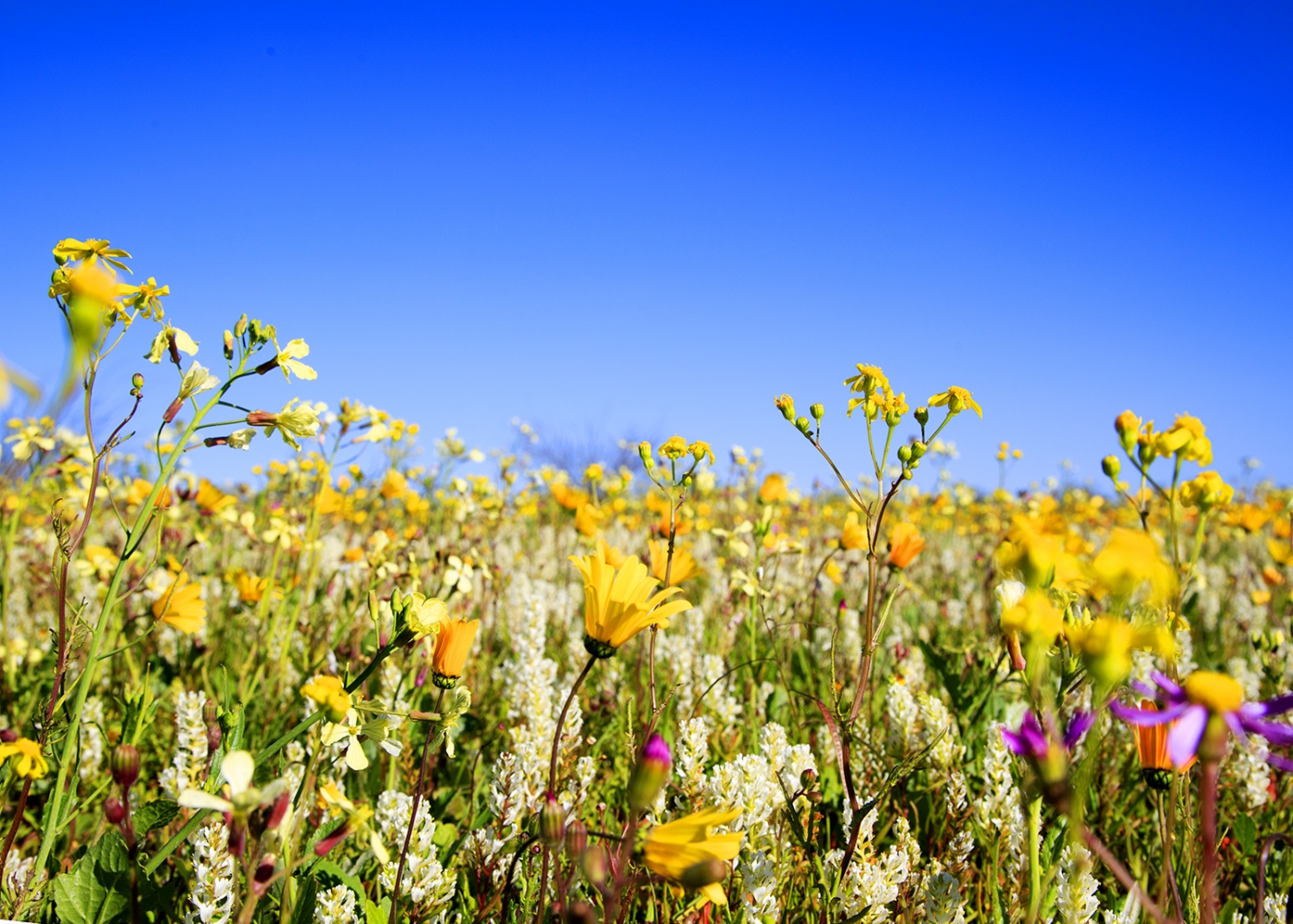
That's true; here, Nature is the artist, and once a year, in spring, a dry, desolate canvas becomes a voluptuous, sensual, intoxicating landscape—an all-consuming garden of nature's delights.


Right now, every social media page, website, newspaper, WhatsApp message, and YouTube clip is about Namaqualand. We are awash in colour and inundated with tips on where to go, what to eat, and where to stay or camp. I will not bore you. If you know the area, you’ll recognise the landmarks. My photos aren't in chronological order, from the start of our road trip in the Cederberg to our last night of wild camping in Strandfontein. I tried, but somehow they got mixed up.


Although Norway predicted the weather, we were not as clued up about wind conditions. On most days, a breeze blew, which made photography a little more complicated. I had to use a fast shutter speed to slow things down, which meant a high aperture, etc.


The sheer magnitude of the vast areas awash in blooms was overwhelming. I tried to capture the “uitblinker”, the individual making a statement. I do love an underdog. We enjoyed walking amongst the flowers where possible, ever mindful of our footprint, but mostly stayed on the verges.


The large herd of Gemsbok (Oryx) we spotted was well camouflaged and distant, but they posed and let us move on.

Although I didn't manage to photograph even a handful of species for later reference and identification, I include some blossoms we saw.

The Honey Badger behaved herself, with no punctures and no surprises. What we struggled with was our Garmin iOverlander and a standard Garmin (yes, we had both). Butch had spent hours plotting our route on his laptop, with waypoints marked, etc. It was frustrating to realise that nothing had downloaded to the devices, no matter what he did. Fortunately, he knew the area well and had memorised the route. We made it without getting lost, and, what's more, we made unexpected discoveries and had a real adventure, just like the olden days.
There are two diesel tanks; when the main tank is empty, a switch activates to pump diesel from the auxiliary tank. The pump failed on the second attempt. Fortunately, we were on our way home, and fuel was readily available.

At my behest, we schlepped the bicycles along. I had visions of going on long rides every day. Sadly, there was no time for that. They would not accompany us on similar trips again. This time, all they did was gather dust.


Ingrid Jonker had the words for what I ruminated on while we drove in our beloved Honey Badger. Oom Piet and Hugo Naudé did the same, splashing on canvas. 2020 is unique in every way; fortunately, there's always a balance. Hope. "All is well with my soul."

Oom Piet had the recipe, the talent and the passion to live in harmony with nature; I wish I'd listened and learned more.
"Flowers... are a proud assertion that a ray of beauty out-values all the utilities of the world." Ralph Waldo Emerson


OUR ROUTE:
- Cederberg Oasis Resort
- Eselbank
- Wuppertal
- Biedouw Valley
- Botterkloof Pass
- Matjiesfontein Farm
- Nieuwoudtville
- Back roads from Loeriesfontein to Garies, bypassing Rooiwalspoort Pass
- Garies
- Kamieskroon (Verby Caravan Park)
- Namaqua National Park (Skilpad)
- Down Grootfontein and Kilians Passes along a 4x4 route to Soebatsfontein
- Klipfontein (Nice tar road) to Garies, Nuwerus, via Lutzville to Strandfontein
- Doringbaai, Leipoldville, Elandsbaai, Dwarskersbos, Velddrif, St Helena Baai, Paternoster
- Vredenburg, Hopefield, Riebeek-Kasteel, Wolseley, Home


Comments


Topics
Latest Photos