Singing Ching-Ching It's Spring
I go ballistic every time Butch announces, “It’s Summer!” (Like clockwork, he does it every year on the 23rd of June). My beady eyes give him dirty looks as I shiver and shake from the cold, but I start watching the signs. And then, when he starts paying attention to the weather forecasts, reads Die Burger’s “Bylaag”, wears last year’s khaki shorts and checks his diary, I know spring is in the air. This year, all the elements aligned on the 26th of August.


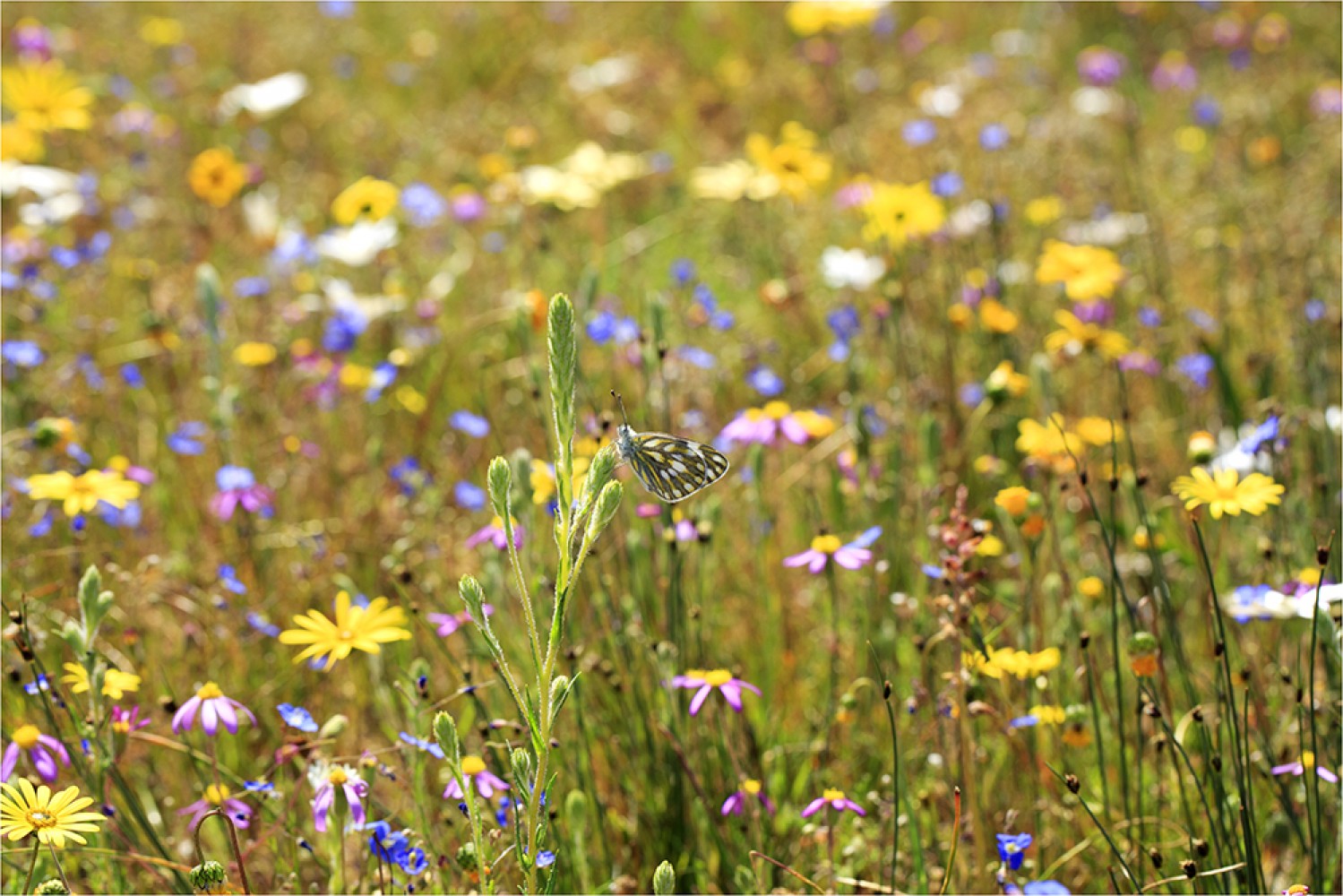
The swallows had returned to their summer nests. As promised, two months early, so we could do a walkabout in Namaqualand during flower season. God had opened his seed bag once again and spread the love, sprinkling seeds on the raw, barren earth where hundreds of millions of tiny, perfect flowers bloom from mid-August for about a month. This spectacle is truly breathtaking, and I want you to experience that awe too. Rumour had it that the fields of blooms were different this year. The rains hadn’t been as widespread or predictable. It’s been a dry year, with El Niño wreaking havoc all around us.


Number 1 on my “Wish List For Life” is: Days should be 32 hours long; I might get through everything I’d like to do. Butch announced, “We’re going to see the flowers tomorrow. I’ve told Megan and Ian. Is it OK with you?” I threw my hands into the air; he thought I was doing a solo Mexican wave. I wasn’t. I was demonstrating. Our small home looked like a bomb had hit it. I’d just returned from my hike in the Fish River Canyon, for Pete’s sake.


When you can’t beat them, you join them. Otherwise, life would be too boring, and I wasn’t going to stay at home and sulk. We’d take a three-night road trip starting at the West Coast National Park. Butch handled all the logistics and bookings and set the GPS to take us on a loop through the most picturesque areas, where the flowers would hopefully be most abundant. Planning makes the experience more enjoyable and less stressful, so I encourage you to check for updates and book early.


Our journey began when we met our friends who’d been away on other adventures. They’d sailed Lake Tanganyika on a yacht before traipsing through Portugal on their now annual walk from Porto to Santiago de Compostela in Spain. We had so much news to catch up on that our throats cried out for coffee and carrot cake, which we enjoyed in Darling.
By then, the sun had burned away the last mists, and temperatures had risen above the desired 18C. The queue of cars waiting to enter the park reminded me of the days when my parents lined up hours before a show to see a film at the Drive-In theatre in White River. The other drivers were angry, impatient, docile, or excited. I had a gut feeling that a child somewhere was going to get a backhander for no apparent reason, as parents waited for service and the staff ran up and down, attending to clients with their Wild cards, cash, and credit cards while the “system” played up. They gunned the engines of their large flat 4x4s in frustration at the delays, sending clouds of dust upwards. Only to slow down to the desired 40KMPH!

We stopped to take our first photographs soon after entering the Park; it was going to be a most rewarding day. An emphatic warning from a German tourist, who stopped and loudly declared, “Don’t waste your time here, guys, you’ve seen nothing yet!” set us on our way. We were not disappointed. The flowers were magnificent, a landscape photographer's dream come true. I could picture watercolourists and artists from years gone by, with their easels and brushes, Panama hats and picnic baskets, setting up for the perfect scene. Sharing these stunning sights can fill your audience with happiness and inspire them to explore.

All the shades of green, with a profusion of yellow, orange, French blue, mauve, and shocking pink, made up the palette on display. Small herds of Eland and Zebra dotted the landscape, filling in the gaps to create a perfect Garden of Eden. On such a perfect day, it was hard to abide by the rules, and happy tourists were eager to frolic amongst the vibrant wildflowers, snapping pictures. I followed suit with a 'selfie' too, capturing the stunning scenery that makes South Africa's floral landscapes so unforgettable.

Hundreds of tourists visit the park daily during this crazy season; to avoid the crowds, consider visiting early in the morning or late afternoon. There is only one restaurant. Unless you pack a basket, you have no option but to visit the Geelbek Restaurant for a cuppa, lunch or breakfast. We arrived in the mid-afternoon, and the place was still packed. I had doubts about finding anything on the menu, but surprisingly we could pick and choose. Our choices included fishcakes, salad, a hamburger and hake and chips. Very good indeed.
I must compliment the staff, who, under very difficult circumstances, consistently serve excellent fare. Nothing has changed here; the Weavers are still weaving their nests in the blue gum trees, the décor is a tad shabbier than chic, the paintings on the walls are still slightly askew, and the staff are still friendly. We couldn’t linger for too long; we had to hurry to Durbanville for a birthday party. We made it, just in the nick of time.


Day two would mark the start of our circuitous drive through Namaqualand. We were the first customers to stop for breakfast at the Flower Festival in Hopefield, a tiny village where time has stood still, and bees produce honey. Everyone is terribly sweet, unspoilt and rather conservative. It would’ve been unkind and hurtful not to stifle our giggles when the naïve schoolgirl, with her notebook and pencil, asked us whether anyone would like a cup of black cappuccino.
We managed a polite “No, thank you!” The breakfast croissant, with its generous slab of Brie and onion marmalade, was delectable; the scrambled eggs were creamy, and the bacon was crispy. I suspect we were too early, and that things were going to heat up in this little one-horse town; probably better, we might’ve overstayed our welcome.


We headed west, hugging the coast and crawling slowly along the railway line, passing tiny fishing villages dotting the shore. Flowers were everywhere, not as profuse as in the West Coast National Park, but abundant, nevertheless.

The allure of the flat, stark, mostly straight coastline is uncanny, as it’s not particularly “pretty” with its evening mists, icy winds, and freezing water. The abundant fish have sustained these poor fishing villages, and the district farmers have, over the decades, holidayed here, dancing the days away and diving for crayfish under the relentless sun. Towns near Cape Town have seamlessly grown into “fashionable” hideaways, with architects recreating Greek-island-style cottages and Uber-cool restaurants popping up.
Reservations are essential for a bed or a table in Langebaan or Paternoster (my favourite place). The left break was flat when we passed Elands Bay, and the local hotel didn’t appeal for tea and cake; here you come to watch rugby on a big screen while listening to fishy tales at the bar.


Isabella’s Restaurant in Lambert’s Bay was our only recourse for tea; it had to be—surprising cakes on offer. We couldn’t ask for more. A perfect day: fishing vessels moored in the harbour, the squall of seagulls and gannets coming in to land, with an excellent cup of Earl Grey tea. Slices are fresh, large, and tasty; the popular Chocolate Ganache cake looked divine—new on the menu, a spicy Apple cake, moist and delicious. Here, the Tannies (aunties) bake. Heavenly.

We watched a perfect golden sunset in Doring Bay—the stillness was a balm after a busy day. Dirt roads led in and out of this quaint fishing village. Spring blossoms had closed for the night, yet they still brightened the simplest cottages, lifting the residents’ weary spirits. In the bay, diamond divers were quietly going about their business, sweeping the ocean floor for its hidden treasure. Die Anker Guesthouse offered a good bed, a hot shower, and a spacious room.
The manageress was friendly and helpful, and she served us an excellent meal in the restaurant. Unfortunately, fresh fish was scarce, so we settled for the usual offerings served at most local restaurants nowadays.


Early to bed, early to rise; it was as we set off to explore the interior of Namaqualand. Breakfast in Van Rhynsdorp. There wasn’t a soul about, though the streets were lined with parked cars. The delightful coffee shop we’d stopped at two weeks ago had a sign hanging all askew: “Closed”. The old Hotel, now a guesthouse, had stopped serving breakfast, and the last guests were on their way. Ca-ching, the penny dropped.
Church. That's where everyone was. TripAdvisor came to the rescue; we had to go to the Engen filling station. Breakfast was in full swing. In the forecourt, day trippers were lining up to fill up with 94, while we sat down to a Boere Brunch or omelettes, light, fluffy and oozing with filling.
An hour later, the streets were abuzz; the pause button had been released. The coffee shop, museum, and nursery were open for business. With a clear conscience, the congregants could indulge in a sweet treat.


We made a slow meander to Nieuwoudtville to see the bulbs and other splendours there. Nieuwoudtville is a small rural town famous for its pretty sandstone buildings, flowers, and gardens, thanks to the variety and abundance of bulb flowers that bloom in this part of the Hantam Karoo in the Northern Cape – the Bokkeveld Plateau.
Like Namaqualand further north, the semi-arid Bokkeveld bursts into spectacular flowers between August and October, when more than 1350 plant species (6% of which are found nowhere else on Earth and a third of which are threatened with extinction) bloom in a profusion of colour and life. More than 40% of these species are bulbous plants – earning Nieuwoudtville the twin accolades of Bulb Capital of the World and Jewel of the Hantam Karoo – an internationally acclaimed biodiversity hotspot.


We were rewarded with perfect weather, but an intermittent breeze kept us on our toes for photography. I opted for my fabulous 100mm Macro lens. This allowed me to get up close to the flowers and really look at what this dry, stony, hard earth had to offer. Poor rainfall, erratic winds, and high, merciless temperatures result in hardier, smaller, low-growing plants and bulbous beauties; moisture is stored in the bulb, and the flowering season is short but wondrous.
Although the flowers were abundant, I missed the huge clumps of sunny Katsterte (Cats’ tails) waving their merry yellow stems in the breeze. This year, there were few. The dry, harsh winter took its toll on them. Matjiesfontein and Papkuilsfontein delivered the goods as usual; we stopped to browse in the "pop-up" dining room, enjoying the banter with the two eccentric ladies who manned the joint.

At Papkuilsfontein, we enjoyed a short tea break with decadent carrot cake and baked cheesecake. Afterwards, we made our way back to Nieuwoudtville to find accommodation for the night. We were tired. Die Nedersetting (The Settlement) was our port of call, where we were welcomed and could secure a bed on a farm a stone’s throw from the village.
Supper was an early affair. Among the works of the famous and not-so-famous South African artists, we dined at Smitswinkel (The Smithy) and had a large plate of traditional Boerekos. Chicken pie, venison pie, and I had fall-off-the-bone lamb neck, slow-cooked to perfection. It was an early night for us.


Satisfied we’d seen the best flowers on show, we made a last detour to the famous waterfall and Quiver Tree forest before heading home on Monday. We’d witnessed the magnificence of this otherworldly natural spring garden in all its glory, like a delicious seasonal fruit salad, wallowing in its splendour and abundance, and relishing its uniqueness. The stark quiver trees were a reality check, the fresh lime-green fields of new wheat in the Swartland a cool respite from the vivid yellows, reds, and oranges of Namaqualand, and the yellow blooms of Canola a jolt. Spring is back, and new harvests are ready for picking! We live in a beautiful country, diverse in every way imaginable.


---oOo---
TIPS FOR A SUCCESSFUL FLOWER TRIP:
•See which areas had rain and plan accordingly
•Bookings for accommodation should be made, but we’ve always found a place, usually with the help of the local tourism office.

---oOo---
WHERE WE STAYED
+27 21 975 4953
What I thought: Underwhelmed. Quite expensive, I thought. Single beds are fine, but single bed duvets leave me cold. Extra blankets and top sheets would do, especially in winter. Bathroom needs a facelift. **/5
Die Nedersetting
All things considered, I thought our accommodations were spot on. New, clean, nicely decorated and functional. Close to the village and all amenities. The cottage is small and the second bedroom very small, but it was totally adequate. The shower was hot with excellent pressure! A lot of thought and effort have gone into this business, and it's well worth supporting. Reasonably Priced ***/5
What I thought: beautiful views of the magnificent sunset. Conveniently situated. Large, neat, well-equipped bedroom with everything we needed. The beds were comfortable, and I was warm. The Manageress was friendly, helpful and considerate. We enjoyed our meal in the restaurant. I would certainly return for a longer stay. Reasonably Priced ***/5


---oOo---
The Meal That Impressed The Most:
3 Kriedoring Street,
7381
+27 22 752 2044
www.abalonehouse.co.za
Our GPS took us into the old part of town, not uptown, but where the fishermen have lived for generations, colourful, vibrant and for tourists, probably a little risque. I was delighted. Reuben, I thought, has moved back to where he belongs, his roots, where his family might have lived (if they ever lived in Paternoster or were anglers). Nope. We certainly were in the right area but way off the mark. This is where Rueben’s belongs and not in the posh, over-the-top Boutique Hotel Abalone House.
On Mondays, most restaurants in Paternoster are closed, so we thought we were very lucky to get a table when we made our reservation. There were only 6 guests for lunch. Sad. The room is beautifully decorated, as befits a fine-dining establishment. I loved the really large wine glasses, the good cutlery, and the fine linen napery. Our server was outstanding; he knew his risotto, that’s for sure. Our meal was excellent, with flavours just right, perfect plating, and portions spot on. Butch had made the perfect choice when he decided this was where we'd have lunch, rounding our trip off 100%.
Sadly, I think the restaurant is too far removed from the eatery scene and the Paternoster buzz. Lacks atmosphere and should be a stand-alone establishment and not part of a Boutique Hotel.
Nevertheless, Rueben does it again. He trains his staff well, has an excellent menu, and serves faultless plates. *****


Comments


Topics
Latest Photos