Nature Calls - Askam And A Meerkat Sanctuary
Before I start this blog, I must explain why I'm publishing it after my Kgalagadi blog, to give context and highlight the importance of conservation efforts in these areas. I always upload my Word documents to my admin page, then add my photographs individually. We are at the mercy of whatever Wi-Fi connectivity we’re in range of. Now, it’s not good.
Slow dribbles with power surges or plunges. I upload the photos from my phone to that website, which is quite laborious and time-consuming. I spent six hours uploading and editing this blog. Finally, when I had finished, I read my blog on the webpage and made final edits. Without expecting anything unusual, I saved and published my blog. Then I clicked onto my website to read and look at the photos.
This time, the blog was gone. It disappeared into cyberspace, almost like a missing sock. I returned to my editing page. Gone. The only explanation: a power surge, a purge, or the Wi-Fi dipping or dropping out while uploading. Who knows? Long story short, my blog was gone.

In an instant, I felt nauseous. I cried; my hands shook. Nothing brought my blog back. My SOS to Jaco, my website designer and cyber guru, didn’t help either. In haste, I did the Kgalagadi blog and, after hours of blood, sweat and tears, posted it at 23h00 last night. I hope it was worth it! This time I’ll keep my fingers crossed. Queen Elizabeth once spoke of an Annus Horribilis. Yesterday was my terribilem diem, but when I read that things were going pear-shaped for Cyril, it became a cacata dies.
The day’s only redeeming features were my office under a tree and the sky’s sunset colours, painting the horizon in hues of orange and pink. Supper was on Butch.


---oOo---

Our week in Upington was nothing but trouble and toil; even my watch seemed to suggest a moment of selfless breathing to recuperate. We both needed to return to the quiet. A bit of dallying and a surf through the SANParks website landed us a seven-night reservation at an exclusive campsite at Nossob in the Kgalagadi, which is essential to book early, since all other campsites were fully booked. We needed it.
After a last check of our vitals, a restocked fridge, and full tanks, we shook Upington’s dust off our flip-flops and headed north to Askham for the weekend.
Askam’s total population can’t exceed a thousand, including the district's farmers. It’s not much more than a pit stop. Dynamite comes in small packages and must never be underestimated. Don’t judge Askam by one dusty street. It has everything a roadie needs.
There’s a filling station, an information centre, a Co-op, a general dealer, the Diamond T coffee shop, and some very nice campsites. We chose pharmacist René’s lovely oasis. Nestled under shady trees and green lawns, we found our perfect spot. We were exhausted, and this would be our footrest for two nights.


We parked the Honey Badger and unpacked our table and chairs on the greenest lawn. At our campsite, Rene had gifted us three hot Roosterkoek. I didn’t have to cook supper; our dinner was served! Such a thoughtful gesture. Thank you, Rene. The other treat was dipping into your pool, meeting your family, and visiting your adorable grandchildren, who had come down to see Ouma.


On Saturday morning, after a late lie-in, we unhitched our bikes and set off for a long ride. A tortoise crossed our path as he travelled from one side of the road to the other. They say tortoises walk away from bad weather and serve as an early warning system. We stopped to photograph him and added the footage to our Grandchildren’s playlist for later. The snake crossing the road was too fast, thankfully, as was the double crossing by the mongrel of banded mongooses dashing hither and thither. They should watch the tortoise.


After our water and snack break, I started to feel unwell. Dizzy, with leaden, painful arms, and even my jaw hurt as if I’d been chewing cud all night, almost as uncomfortable as the cramps in my calves. Thankfully, this was the second bout in recent weeks, though not as severe. I knew I’d make it back to camp, unlike the first time in the Richtersveld, when I thought I might pop my clogs.
Rene, our hostess, gave me a diagnosis. Dehydration. After ample rehydration with suitable electrolytes and a large dose of water, I’m happy to report I’m back to my old self. The sudden heat, dry air, altitude, and irregular mealtimes had taken their toll on us oldies. We’re getting the knack for acclimatising, even if it takes time. In Keetmanshoop, I stocked up on Nuun electrolyte fizzy tabs from the health store in the Mall. They're my favourite. Sugar-free.


Stopping for a double-thick coffee milkshake at Diamond T Coffee Shop did wonders. They're famous for their pies, milk tarts (a must), and milkshakes. Everyone on the stoep had one. After a long breather, a chat, and a catch-up, we were ready to tackle the tasks we’d set ourselves for the day. We took winter out of our Honey Badger and packed it all into our new rooftop locker.


Diamond T was the beloved car of the land and of the shop's first owner. He loved it so much that he named the shop after it. The name has stuck.

Jerseys, spencers, woollen socks, slacks and tights, winter linens and blankets have been bagged and stored for another season, far in the future. We collectively sighed in relief. The inside lockers were closing easily again. It always surprises me that once something is out of sight, it’s invariably out of mind too.

It didn’t take Butch long to click-click through the steps, extend them to full length, and hook them up to nip up and open the locker. It is so spacious that he soon had everything stowed. There’s plenty of room for more, but for now we’re relieved to have put winter away for another day. We celebrated with Bubbles. My grooming didn't go according to plan. Bi-focals don't cut it. I only realised this when a Meerkat took a nap on my recent pedicure! Red nail varnish everywhere!


---oOo---
On Sunday, we packed up early and headed ever north to the Meerkat/Suricate Sanctuary, twenty kilometres from the Kgalagadi’s main gate. Anne's iconic green Landie sat parked in the driveway, ready to roll.

Until she died in 2020, Anne Rasa lived on the cattle farm she bought in 2000. With help, she rehabilitated the dunes and the veld.

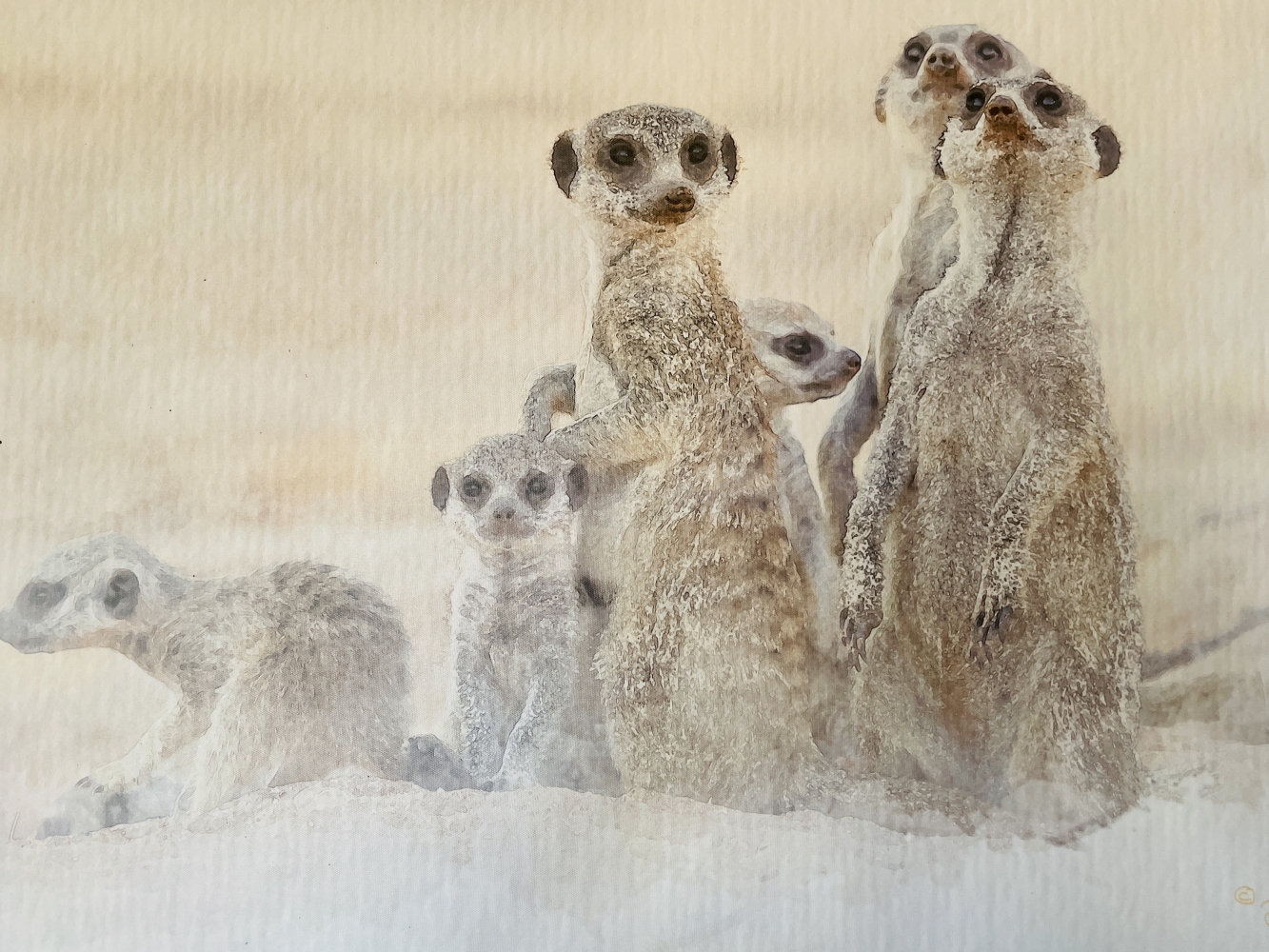
Mareli met us at the sprawling homestead with her newly adopted Meerkat, Paddington, who chittered incessantly, vying for all her attention. This hyperactive “child” kept her on her toes. Mareli was smitten. Paddington was seven weeks old and had been in her care for three weeks.

Paddington was a victim of the poaching of wild animals. A concerned farmer spotted the newborn in captivity and rescued him, or he would've been sold for R8k. Contrary to popular belief, Meerkats make terrible pets. The cute, cuddly baby soon becomes a demanding, possessive and jealous animal, causing havoc and destruction wherever he goes. Once-happy owners soon get bored with their tantrums and demands and neglect them. Meerkats are social animals and need to live in family groups to survive. Once a baby is removed from the unit, it will not be accepted back and must find its way alone.


Our campsite, in the veld with the watering hole to look out onto, was perfect for Jock of the Bushveld, and all I needed was to see Jock run around the bushveld to complete the scene. We’d outspanned. With our chairs and table set up under an Acacia tree, we did a spot of bird-watching and hoped the Eland spoor around our campsite was a good omen.


As the air cooled later in the afternoon, we took a quick bike ride to watch the sunset over the dunes. Although skittish animals fled as soon as they caught our scent, we saw several plains antelope.


On Monday morning, Butch decided to start the week off on the right pedal, as one does, and took me out for a 42 km ride. The farthest we’ve ever cycled. We took the tar road to the Kgalagadi’s main gate—a gentle ride along the Nossob River. Up, up, up the gradient worked my muscles. “These hips don’t lie” went through my mind as I slogged on—a quiet road, with only a few mules, cattle, sheep, goats, and ponies as onlookers. Separated by a little fence, we could see Botswana’s overgrazed, dry, red sand.


In the past, we had looked at that fence, wishing we could venture further afield; this time, if it pleased us, we could go anywhere, in any direction, knowing no deadline held us back—the joy of declaring your innings. Butch mused.
Seeing the sun set red over a windswept Kalahari dune is everyone’s dream, and we took up Mareli’s offer to take us on a sunset drive to enjoy our drinks on a dune overlooking the farm. Later, we switched on flashlights when the evening star appeared, and the sickle moon shyly crept over the horizon as we took a circular route to watch nocturnal critters come out to forage.


Owls, hares, barking geckos, a lone klipspringer, a herd of Springbok standing stock-still, their eyes shining in the light. We were all hoping for an aardvark, of course. In the silence, Butch nudged me in the ribs. “Are you sleeping?” he enquired in a stage whisper. I’d started snoring. Busted.
I encourage you to consider spending a night or two at the Meerkat Sanctuary as an alternative to entering the Kgalagadi. You can also commute from there to the park for day drives if you can't find accommodation at Tweerivieren.
The rangers do a remarkable job of conserving the most vulnerable, often overlooked animals, including the Meerkat. The park offers simple, comfortable accommodation options, such as cottages, rooms, or camping facilities. Mareli makes excellent iced coffee while visitors relax on the wrap-around veranda, enjoying the birds and Meerkat antics that abound on the werf.


Our sunrise excursion to check on the newborns in the veld was another option for guests. With Mareli guiding us, we walked to the burrows. While quietly waiting for the adults to emerge, then the littlies, we enjoyed the cool air and the sunrise. Shortly afterwards, the babies started skittishly scampering from the den. Observing animal behaviour, while exciting and rare, is how we learn about them; it can change a life. One's prejudices change too.


Anne Rasa, a Welshwoman passionate about nature, conservation, and animals, established it 30 years ago. She retired to the farm after years spent in Kenya. Her story is remarkable and romantic; her eldest son’s father is a Hawaiian surfer! Her commitment to conservation should inspire a film! Laurens van der Post also explored these dunes in his search for the Bushmen.
I regret having driven past this lovely location, with its history and story, so many times. My time there was worth every second and made me realise how generous people are with their time and expertise, sharing them with us in the hope that we become more aware and do better.

---oOo---
A little bit about Anna Rasa according to Wikipedia
“Olwen Anne Elisabeth Rasa (1940 – 15 November 2020) was a British ethologist known for her long-duration study of the social behaviour of the dwarf mongoose in Kenya. She had studied aggression among coral reef fish under the pioneering ethologist Kond Lorenz.
Her fieldwork in Kenya’s Tana River led to the book Mongoose Watch: A Family Observed and the famous German television series Expedition wins Tierreich. She later studied social behaviour in the yellow mongoose and the sub-social tenebrionid beetle Parastizopus armistices.
Rasa owned the Nature Reserve Kalahari Trails at the southern end of the Kalahari Desert in South Africa, which she bought a few years before her retirement. She lived on the farm from 2000 and offered accommodation and guided walks to anyone interested in the Kalahari's flora and fauna.
In 2007, OSHANA published KALAHARI – Magnificent Desert, featuring photographs and text by Rasa.
In 2011/2012, Rasa served as a scientific adviser on a film series called Kalahari Trails, filmed in the Kalahari.
Rasa had three children and four grandchildren. She died on 15 November 2020.
One lady who joined us on the sundowner drive couldn’t speak more highly of Anne, telling us about her guided walks in the veld and their sighting of an elusive Aardvark. Fortunately, Anne's legacy lives on.
*KALAHARI CAMELTHORN GUESTHOUSE AND CAMPGROUND.
Contact Details:
René van Wyk
Tel 082 330 6762
072 437 6969
95 Vaalkameelboom Street
Askham
8814
PO Box 73
[email protected]


Comments


Topics
Latest Photos