Who Let The Dogs Out?
Who let the dog out? And what's more in the Kalahari to boot!
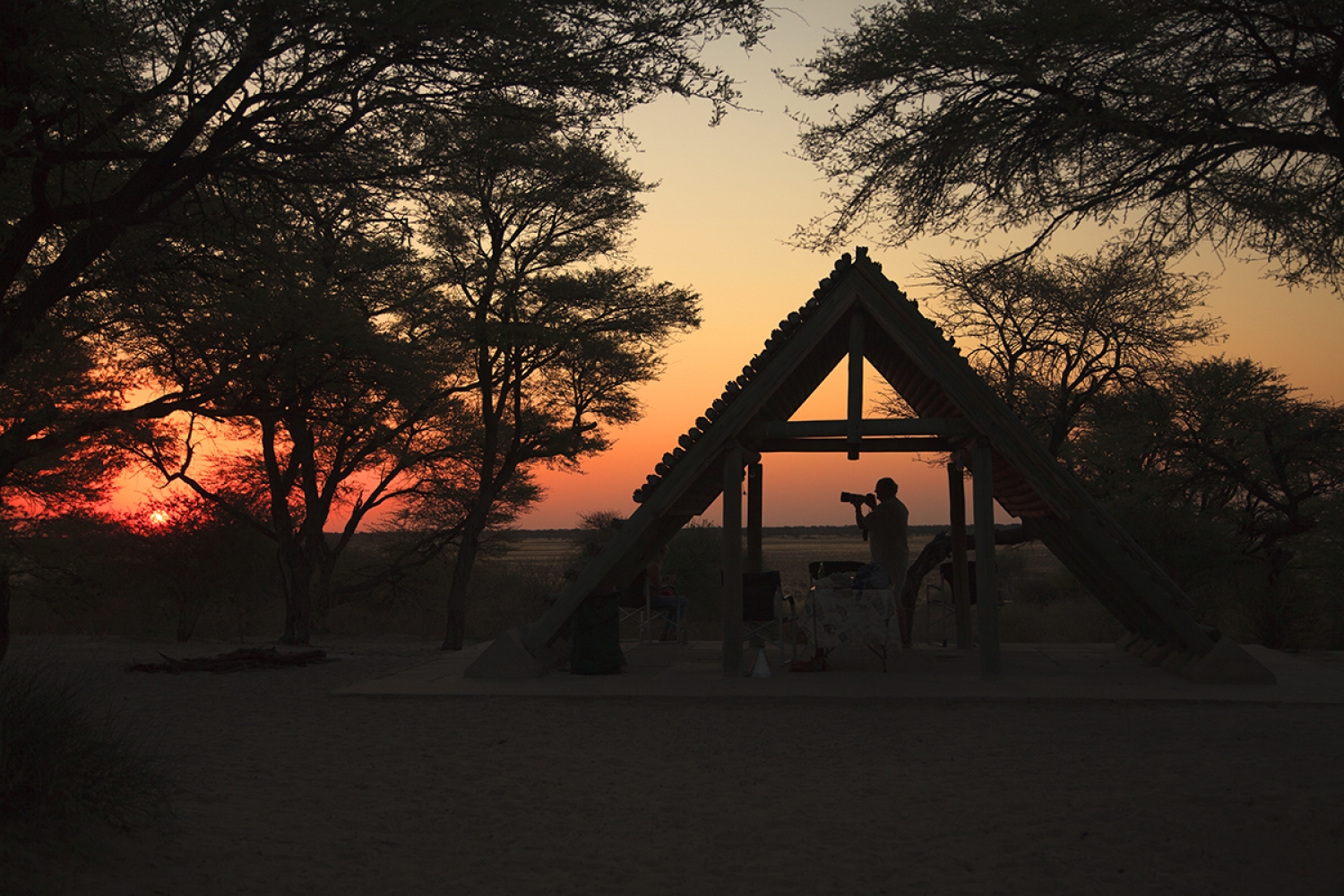
So, there we were, minding our own business, watching another beautiful African sunset, contemplating the day, sipping drinks, when a Land Cruiser came hurtling up our road in a billowing cloud of dust. My stomach lurched, and I do confess I felt nervous. Four men were on board: two sat on a sky-high bench with an aerial, a driver, and one other in the shotgun seat. They stopped in a hail of gravel, jumped out and approached us.

This is Africa. They were kitted out in Khaki, sunglasses, cameras, and hats. Without preamble, the driver enquired, “Did you see the dogs?”
Dogs? What dogs? African Wild dogs, of course. “No!” we exclaimed, rolling our eyes. Nice one! But we did have clear hyena spoor. One that had pulled up our ground sheet, notwithstanding the 6” brass pegs holding it down, dragging it off a few meters before losing interest. The men were interested. They looked and announced. “That’s them. Our pack of Wild dog pups. We’re looking for them” Just like that.
As Butch said later, “If someone had told me there are wild dogs in the Kalahari, I’d have thought they’d got bush fever and lost it.”
We were speechless. Apparently, our campsite was their playground and the path they used from their den down to the pan to hunt. Like dogs nodding on the rear windowsill of a car, we nodded and shrugged. The men returned to their vehicle; they were on a mission to find their dogs.
Thrilled with our identification of the spoor, we went to inspect them again—this time, full of wisdom. Butch reminded Sue and Percy of our Wild dog experiences in Mana last year. How special it was to see these rare animals, and filled them in about their habits, unique markings, breeding habits and what ferocious hunters they were. Sagely he warned, “Chances are good we’ll not see them.”
The next minute, the Land Cruiser was back. The yearlings were on their way to the pan, and if we followed the crew, we might see them on the road before they crossed over. We jumped at the opportunity and went tearing, at a respectable speed, off behind them.


With huge smiles, the men pointed them out and allowed us a perfect view of the five dogs crossing the road. Without missing a beat, they were off on their hunt. They’d spotted some ostriches on the far side of the pan, and the hunt was on. We watched from the sidelines and saw how their interest changed when they spotted a lone springbok. Everything they do is instinctive. How they form their pincer movement, one dog leading the way, the rest spreading out, some lagging slightly, conserving their energies for later when they take over from the leader as the buck tires, slows and eventually gives up the chase. Within minutes they’d sprinted many hundreds of meters through the grasses and scrub until the Springbok saw a gap and headed for thicker and denser Acacia trees and shrubs. The dogs were determined, energetic and hungry.

Unfortunately, we couldn’t go off-road and had to turn back. We didn’t witness the kill but were promised full disclosure later. We waited impatiently as we saw the tracking lights sweep their beam over our campsite during the night. Like excited children, we couldn’t wait for the debriefing, speculating whether we’d be privy to the discussions. We were the outsiders after all.

The next morning, over steaming cups of coffee and rusks, we got the entire story. A kill was made; the dogs, hungrily fed, tore at the meat in great gulps until they’d finished every scrap, always mindful of other predators and scavengers like lions and hyenas who would not think twice before chasing these yearlings off the kill.

Once they’d finished eating, they’d return to their den to regurgitate and feed the lactating female. Because the new pups were still denning, it was unknown how big the litter was. These pups were most vulnerable, and the den's location was a closely guarded secret. Dens are frequently vacated, and new dens are found; aardvark holes are the most popular as they’re large, deep and very safe. A predator is unlikely to rob the den. But the tracks going to and from the den are a problem. Cats walk in paths, are very keen spotters of paths and will soon uncover a track, especially vehicle tracks, which is why we’d never know the location. Leopards are opportunists, and their modus operandi is to watch behaviour. They note recurring behavioural patterns and, when the opportunity arises, strike. Another interesting fact is that relocation often happens at midday, when nocturnal hunters slumber.

When I said I’d be loath to mention specific sites, the guide said, “You can bring 100 tourists; they’ll never find the den!” I was relieved. So their secret place is safe for now.


This tight-knit group of men consisted of Botilo, studying for his doctorate on the wild dog, a fascinating, knowledgeable man who’s travelled the world and, with great humour, sees human behaviour for what it is. A natural leader and an eloquent teacher. He is a scientist with a passion for wildlife, especially the African Wild dog.
Their mentor and research assistant, Mmoloki, was an accomplished guide who’d mentored many graduates in animal behavior, whose vast practical knowledge and skill were honed in the field. A fascinating man who had us all enthralled with his wisdom and plain speaking!
Mackenzie, a KRC Research Intern doing his practical and a very keen photographer, intelligent yet wise for one so young, whose photographs will one day be snapped up by National Geographic, I am sure.
Their tracker, Cooper, is one of only three trackers in Botswana and is considered the best of the best. His grandfather taught him, as his ancestors had for many thousands of years. This shy, softly spoken man, who spoke perfect English, always looked to Mmoloki for guidance with so much respect; he listened, contemplated, and then answered my questions, revealing only what he considered important. I think he studied us as he studies the Kalahari sands and read us like he does a paw print, getting all the answers from the signs we leave in our wake.
A rare opportunity presented itself, and we grabbed it with both hands, enjoying the camaraderie, the knowledge and stories shared. We spent a most enjoyable hour or two before they had to leave to restock their supplies and freshen up. We saw them again later that afternoon.
We decided to stay at our campsite for the day, hoping to spot the dogs as they passed us. Unfortunately, we didn’t, as expected, but we did have an opportunity to see them return at sunset and set out on another hunt, this time getting their kill on the pan, which we were fortunate to glimpse from afar.
“Ninety percent of everything we know has been passed along through story.” ― Laurens van der Post.

HOW CONSERVATION WORKS AND THE CULLING OF THE BOTSWANA ELEPHANTS, A LOADED CONVERSATION
In June, the Botswana Government announced that hunting elephants would be allowed and the ban lifted. I was horrified.
During our conversations with the group, I asked for their opinion. They unanimously agreed that it is a good thing. Why? I asked.
Their explanation was the following:
The people of Botswana co-exist with the animals. There are no fences. Animals migrate naturally, and humans and animals share a strong bond and mutual respect. Cattle ranching is a huge source of income in Botswana. Rural communities and their livestock have to be protected. In some instances, farmers have been discouraged from cattle ranching and are supported by the Community Trusts.
Elephant numbers have increased dramatically over the last few years, decimating trees as they need large quantities daily (In a day, an elephant can drink 200 litres of water. Elephants eat roots, grasses, fruit, and bark. An adult elephant can consume up to 200kg of food in a single day.) Elephants are also preyed upon, which means lions, cheetahs, leopards, and other scavengers will follow; this puts livestock farmers under added pressure to protect their herds—the circle of life. Disrupt one, and we open another can of worms.
Elephants are very clever and have survived using instincts like fear and flight. Therefore, elephant herds will vacate a location if they fear for their lives and naturally relocate to a safer area. The reasoning is that by culling 5 elephants in an area annually, the herd will move to areas where they are not hunted, such as national parks where they’re safe.
Relocating one elephant costs $15K or more; relocating a herd costs many thousands more. International hunters, under supervision, are willing to pay thousands of dollars to cull. All funds raised will go to the community trust, which is managed transparently. These funds are used to uplift communities and build schools, hospitals, and clinics, which benefits the whole community. Herds naturally move to protected areas, which is less stressful for the animals. Hunters are mainly interested in trophies, which means the meat can provide much-needed food for that community too.
The ban on ivory will be upheld, and tusks will be safeguarded in vaults and not sold.
I realised these learned men, who have considered and scientifically studied all scenarios realistically and understand conditions, traditions, and local lore, had a point. To co-exist, a fine balance has to be maintained. In Botswana, conservation is a top priority. Tourism is their main source of income; they certainly don’t intend to bite the hand that feeds them.
Years ago, I read somewhere that we find answers to many questions when we are under pressure; for example, groundbreaking medical research was done during the most devastating battles and wars. When animals are on the verge of extinction, means are employed to save them; when humans die from epidemics like HIV, Measles, smallpox and polio, we find cures. When plastics threaten our oceans, we ban single-use plastic and find alternatives. Sometimes we have to be unemotional and find ways to save our planet and all its creatures.
Ian Player said, “We believe that interest in nature leads to knowledge, which is followed by understanding, and later, appreciation. Once respect is gained, it is a short step to responsibility and ultimately action to preserve our Earth.
Thank you, guys, for showing us the way; without your kindness, generosity, wisdom, willingness to teach and show, we’d have missed the greatest sights of all. I hope we will all meet up again somewhere sometime; it’s a sad thought to think we might miss out on your great adventures. I know we will read about you in the future.
You reminded us of the African Wild Dog’s precarious position and fight to survive, but, most importantly, that we must tread softly on this earth. Botilo, Mac Kenzie, Cooper and Mmoloki, you do just that. You are an inspiration, and you’ve rekindled our hope and desire to see our beloved Africa reach its full potential. Who knows, one day the animals might roam freely and in large numbers again.
Thank you.

Comments


Topics
Latest Photos